
A Note From The Founder,
When I started thinking seriously about what Fairways Africa could be, what stories it needed to tell, whose voices had been missing from the conversation, one name kept coming back. Aziz, Kenya’s number one golf influencer. Not because he is the loudest voice in Kenyan golf, though his platform speaks for itself, but because he is doing something quietly radical that this industry has not yet fully stopped to appreciate.
He is making the game of golf belong to more people.
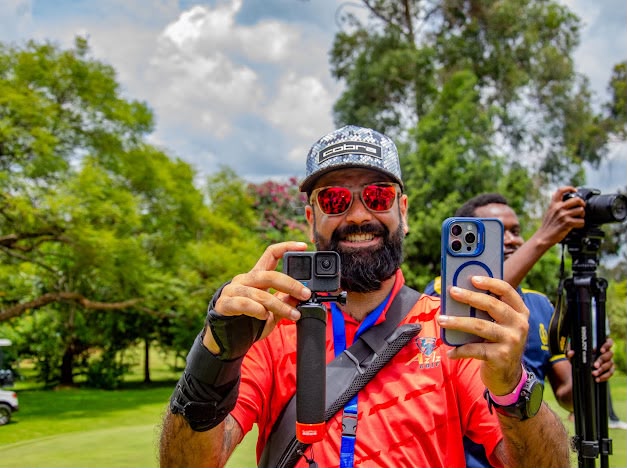
I have watched him walk into spaces that were not built for him, with a camera and an unshakeable belief that golf in Kenya deserved to be seen. No blueprint. No institution behind him. Just a passionate golfer who understood, before most, that the future of this game would be decided on people’s phones.
What Aziz represents goes beyond one influencer. Golf influencing is one of the most underleveraged assets in Kenya and in Africa’s golf industry. Every stakeholder, from clubs and federations to corporates, has something to gain from taking it seriously. A well-partnered influencer puts brands in front of thousands of eyes and an entirely new audience. It does what no billboard, no tee sign on the tenth hole, no membership drive, no club noticeboard, no industry dinner, and no press release can do: they make someone who has never thought about golf pick up their phone, watch a reel, and think maybe that is for me. That conversion is worth more than most marketing budgets will ever honestly measure.
As a publisher, featuring Aziz in Fairways Africa’s first major profile is not just an editorial decision. It is a responsibility. If our mission is to tell African golf’s story to the world, we cannot do that without spotlighting the person who has been telling it longest. Long before platforms like this one existed to amplify it.
To all, enjoy the read.

Camera
& Tripod
the fairway rules in Africa

Right now, golf is in the middle of a strange and exciting reinvention. It has become huge in the U.S., Europe, and increasingly in Africa too. Surprisingly, it isn’t being led by tournament officials or federations but by influencers with cameras. It is being systematically reimagined on YouTube, Instagram, and TikTok, where golf influencers like Az Izz Golf are doing the heavy lifting of growing the game by changing the narrative, breaking the old stereotype that golf is just a stuffy, closed-door sport, exclusive, turning it into something that looks fun, accessible and worth watching opening it up to a younger, dynamic, and digitally connected generation. Golf for Everyone.
Not many Kenyan children grow up with a golf club in their hands. Aziz did. Long before junior golf had a proper home in this country — before clubs opened their doors to young players, before anyone seriously asked what the game could look like if Africa started early — a father handed his son something that would quietly shape the rest of his life. From the very first time he stepped onto a course, something took hold. A pull toward the fairways and the range that never really loosened. Watching Tiger Woods, Justin Rose, and David Duval light up a television screen only deepened that pull into something closer to certainty. “I knew deep down that I would do something golf-related,” he says. “And here I am today, living that out.”
The page that would become one of Kenya’s most recognised golf platforms did not start with a media vision. It started with clothes. Aziz launched Flora Trend, a golf apparel venture that caught fire quickly — orders coming in, a community forming, early momentum that felt like proof of something real. Then the stock ran out. Rather than let the page die, he pivoted. “I didn’t want the page to go stagnant,” he explains. “Since I’ve always loved filming golf videos, I decided to post those instead.” His early audience was small and close to home. But the numbers grew. Slowly at first, then beyond Kenya, then beyond the continent, until a page that began selling golf shirts was reaching golfers across the world.
From the outside, golf influencing is easy to misread. To the casual observer, it looks like a young man living his best life on a fairway — good weather, great shots, a camera rolling. And sometimes, it is exactly that. What that picture doesn’t show is what Aziz is actually doing: the hours behind the edit, yes, but more than that, the weight of what he has chosen to carry. In a country where golf has spent decades wearing the wrong reputation, every video he posts is quietly arguing against it. That golf is not boring. That it is not only for the wealthy. That it can belong to the kid who has never set foot on a course but stumbles onto a reel and feels for the first time that maybe it could be for him. He is not just filming a game. He is dismantling a stereotype — the same one that nearly kept him out — one reel at a time.
No journey worth telling comes without its obstacles. As a junior, Aziz did everything possible to earn a handicap — the basic credential that would allow him to compete — but was denied simply because he was considered too young. The rejection hit hard enough to walk away. He turned to other school sports and left the clubs behind. It wasn’t until a new board came in with a real focus on junior development that he got his shot — and started winning tournaments.
“He is not just filming a game. He is dismantling a stereotype — the same one that nearly kept him out — one reel at a time.”
Then came a new chapter and a new set of walls. Nobody handed Aziz a blueprint. When he decided to bring golf content to life in Kenya, there was no roadmap, no industry to plug into, no community of influencers who had done it before him. He was figuring it out in real time, and the reception wasn’t always warm. Walking into country clubs with a camera and a tripod was not the welcome sight it might seem today. Golf in Kenya has had a very particular idea of what it was supposed to look like, and a golf influencer showing up with camera gear and ambition did not fit the picture. At one point, a prestigious club quoted him KSh. 200,000 just to film a casual scramble match. Not a broadcast. Not a production. Just a scramble match for Instagram and YouTube. The gatekeeping was not always loud, but it was consistent. The message, spoken or unspoken, was that this space had rules and his kind of content was not yet one of them.
“People often don’t appreciate the workload behind content creation. They assume a free lunch is enough payment.”
Today, the biggest battle is a quieter one but no less real. Undervaluation. The assumption that a golf influencer’s work begins when the camera starts rolling and ends when it stops. That a free round and a free lunch are a fair exchange for the hours spent planning, filming, sorting, editing, and uploading. “People often don’t appreciate the workload behind content creation,” Aziz says plainly. “They assume free lunch is enough payment.” For him, content creation is real work and not a hobby.

But perhaps nothing speaks louder about how far Aziz has come than who has taken notice beyond Kenya’s borders. L.A.B Golf, the American putter brand behind J.J. Spaun’s win at the 2025 U.S. Open at Oakmont and Lucas Herbert’s recent record-low round at a LIV Golf tournament en route to winning the 2026 LIV Golf UK, a brand in the bags of PGA Tour and major winners Adam Scott, Rickie Fowler, and Lucas Glover, sent him a free arm lock putter. Unsolicited. No pitch, no proposal, nothing negotiated. Just a package, because his content had traveled far enough that a company at the top of the golf equipment world noticed and, on its own, decided he was worth the gesture. That matters. It says something about where African golf content sits globally right now.
Then there is Justin Rose. The same player Aziz had watched on a television screen as a boy in Nakuru, the man who had helped shape his earliest belief that golf could be his future, is now engaging with his page. Rose’s caddy Fooch follows him too. DP World Tour players have collaborated with him during the Magical Kenya Open. These are not courtesy interactions. These are professionals at the highest level of the game choosing to engage with a Kenyan influencer, and that’s a signal to every young influencer in Kenya, Rwanda, Ghana, and Nigeria: the ceiling they assumed was there isn’t. It tells every club, golf federations, and corporates that African golf influencing isn’t a local story anymore. It is a global one, and Aziz is already in the room.

Closer to home, the impact is just as significant. He has become the face of some of Kenya’s biggest golf events — official influencer for the 2026 Tannahill Shield Easter Tournament, the inaugural Mount Kipipiri Open, and the Golf Hotties event. He is not just a creator with a camera; he knows the golf terrain, he brings energy, high-quality coverage, reach, and a new audience to everything he touches. At the Magical Kenya Open, he manages John Lerjima, one of Kenya’s most promising young talents, and became the first influencer to shoot behind-the-scenes YouTube content at the event, taking viewers somewhere no broadcast camera had gone before. He shot Kenya’s first-ever full 18-hole YouTube match, a round that broke 60, and his reels have crossed a million views and set a new benchmark for what golf content in this country could look like.

Finally, Aziz isn’t thinking small. His ambition is to make golf in Kenya and in Africa so visible, so alive and so undeniably compelling that the next generation does not need to be convinced to pick up a club. They just do. Because they grew up watching someone who looked like them play on courses that belonged to them. He wants influencer presence to become standard at every sponsored golf event in the country, not an afterthought or a courtesy invite. He wants to see influencers like himself embedded at elite professional and amateur tournaments, telling the story of the game from the inside, in real time, for audiences that are growing faster than the industry has caught up to. He wants full YouTube broadcast rights for Kenyan golf events, live coverage, behind-the-scenes access, the kind of immersive content that turns a casual viewer into a devoted fan. And beyond all of that, he wants a dedicated YouTube Golf Tour, an African golf content ecosystem built entirely on its own terms, that does not wait for the global game to look this way but becomes impossible for the global game to ignore.
The next chapter of African golf is being written and won’t be written by whoever has the biggest budget. It will be written by whoever moves first. The audience is already built. The reach is already proven. What is left is an open door. For corporates, sponsors, and federations who want to be part of where golf in Africa is headed, this is that moment to partner with the person already doing the work now, or pay more to catch up to him later.